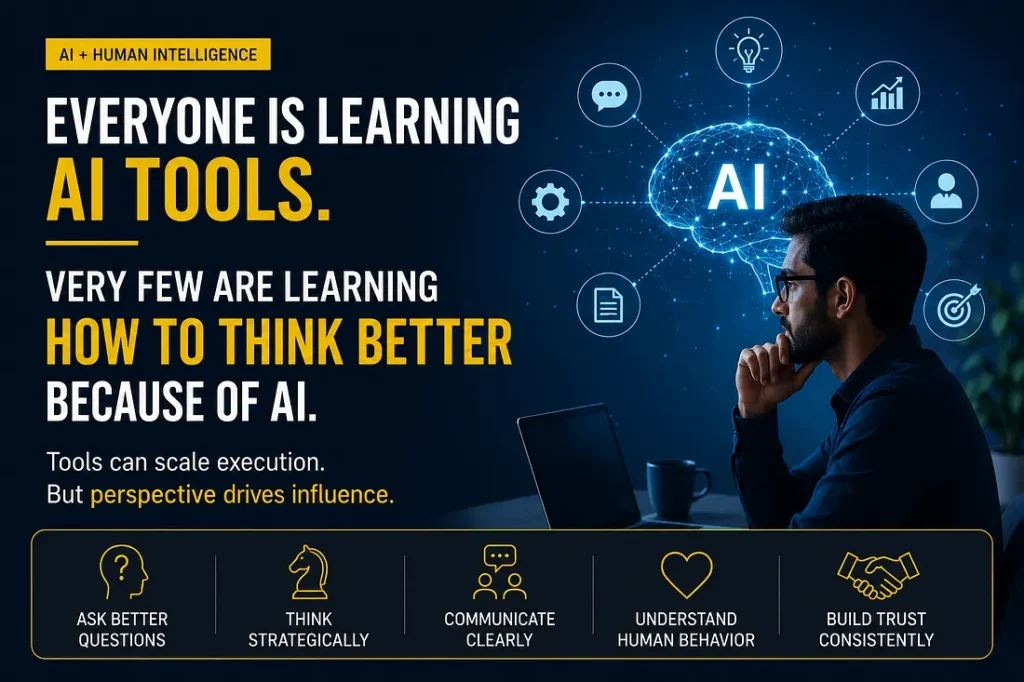

Most people are learning AI tools, but few are learning how to think better because of AI. Discover the mindset that will matter most in the AI era.
Artificial Intelligence has become the hottest topic in business, technology, education, and almost every professional conversation.
Every day, new AI tools appear.
People are learning how to write prompts, generate images, automate workflows, create videos, summarize meetings, and even build applications without writing code.
LinkedIn feeds are filled with posts about the latest AI tools.
YouTube channels publish hundreds of tutorials every week.
Courses promising “Master AI in 30 Days” are everywhere.
Yet amid all this excitement, something important is being overlooked.
Most people are learning AI tools.
Very few are learning how to think better because of AI.
And that difference may determine who thrives in the next decade.
The Real Purpose of AI Was Never Replacement
Many people view AI as a shortcut.
Need content? Ask AI.
Need ideas? Ask AI.
Need answers? Ask AI.
While these applications are useful, they represent only a small fraction of AI’s true potential.
The greatest value of AI is not that it can think for you.
The greatest value is that it can help you think better.
This concept aligns closely with the idea of intelligence amplification—the use of technology to enhance human reasoning, decision-making, and learning rather than replace it.
The professionals who gain the most value from AI are not necessarily the ones who know the most tools.
They are the ones who use AI as a thinking partner.
The Danger of Outsourcing Thought
Imagine two professionals.
The first uses AI to generate reports, emails, presentations, and strategies without questioning the outputs.
The second uses AI to challenge assumptions, test ideas, identify blind spots, and explore multiple perspectives before making decisions.
Both use the same technology.
Yet their outcomes will be dramatically different.
The first person becomes increasingly dependent on AI.
The second becomes increasingly intelligent because of AI.
Recent research suggests that excessive reliance on AI for direct answers may weaken problem-solving abilities and independent thinking if users stop engaging deeply with the learning process.
The question is not whether AI is making us smarter.
The question is whether we are using AI in a way that makes us smarter.
AI Is Creating a New Competitive Advantage
Historically, access to information created an advantage.
Then the internet democratized information.
Next, search engines democratized discovery.
Now AI is democratizing expertise.
If everyone has access to powerful AI systems, then simply having access is no longer an advantage.
The competitive edge shifts elsewhere.
It shifts toward:
- Better judgment
- Better questioning
- Better reasoning
- Better decision-making
- Better creativity
In other words, thinking becomes the differentiator.
AI can generate thousands of ideas.
Humans still decide which ideas matter.
AI can provide recommendations.
Humans still choose the direction.
AI can process data.
Humans still determine meaning.
That is why critical thinking may become one of the most valuable skills in the AI era.
The Quality of Answers Depends on the Quality of Questions
One of the most fascinating lessons AI teaches us is the importance of asking better questions.
Poor prompts produce generic results.
Thoughtful prompts produce deeper insights.
Over time, many professionals discover something unexpected.
The challenge is not getting answers.
The challenge is learning how to ask better questions.
This habit extends beyond AI.
People who ask better questions:
- Solve problems faster
- Learn faster
- Lead more effectively
- Make better decisions
- Create better innovations
AI rewards curiosity.
And curiosity is fundamentally a thinking skill.
AI as a Personal Thinking Coach
Most people use AI as an assistant.
Few use it as a coach.
Consider these examples:
Instead of asking:
“Write a marketing strategy.”
Try asking:
“What assumptions am I making in this marketing strategy?”
Instead of asking:
“Summarize this report.”
Try asking:
“What perspectives are missing from this report?”
Instead of asking:
“Give me the answer.”
Try asking:
“Help me think through this problem step by step.”
The difference is profound.
One approach seeks convenience.
The other seeks growth.
The second approach develops judgment, reasoning, and intellectual flexibility.
These are skills that remain valuable regardless of how technology evolves.
Why Human Thinking Still Matters
Despite remarkable advancements, AI does not truly understand the world the way humans do.
AI recognizes patterns.
Humans understand context.
AI predicts.
Humans interpret.
AI generates possibilities.
Humans create meaning.
Researchers studying human cognition and machine learning continue to emphasize that human intelligence relies heavily on causal reasoning, contextual understanding, and the ability to transfer knowledge across unfamiliar situations.
This distinction matters.
In business, leadership, relationships, ethics, and innovation, context often determines success more than information.
And context remains deeply human.
The Rise of AI Literacy
The future is not about becoming an AI expert.
It is about becoming AI literate.
AI literacy includes:
- Understanding what AI can do
- Understanding what AI cannot do
- Recognizing biases and limitations
- Knowing when to trust outputs
- Knowing when to challenge outputs
- Using AI responsibly and strategically
Experts increasingly describe AI literacy as a combination of technical understanding, practical usage, and critical evaluation.
Just as digital literacy became essential in the internet age, AI literacy is becoming essential in the AI age.
But literacy alone is not enough.
The goal should be enhanced thinking.
The Most Valuable Skill of the Next Decade
Many people ask:
“What skill should I learn to stay relevant?”
The answer may surprise them.
Not prompting.
Not automation.
Not even AI itself.
The skill may be learning how to think clearly in a world filled with infinite AI-generated information.
Future leaders will likely be those who can:
- Distinguish signal from noise
- Evaluate competing viewpoints
- Make decisions under uncertainty
- Think critically
- Think creatively
- Think independently
In the era of Digital Transformation Services & Technology changes.
Human judgment remains essential.
Even leading voices in technology increasingly emphasize that uniquely human qualities such as judgment, communication, empathy, creativity, and taste will become more valuable as AI capabilities expand.
A Practical Framework for Thinking Better with AI
If you want to use AI as a tool for intellectual growth rather than dependency, follow these five habits:
1. Ask AI to Challenge Your Ideas
Invite disagreement.
Seek alternative perspectives.
Explore the AI Services
2. Use AI to Explore, Not Just Execute
Focus on understanding rather than speed.
3. Verify Important Outputs
Never assume correctness.
Validate critical information independently.
4. Reflect Before Accepting Answers
Pause and evaluate.
Why is the answer reasonable?
Could there be another interpretation?
5. Use AI to Learn New Mental Models
Explore how experts think.
Study frameworks, systems, and reasoning patterns.
These practices transform AI from a productivity tool into a learning accelerator.
Way Forward
The AI revolution is not just changing how we work.
It is changing how we think.
Many people are rushing to learn the latest AI tools.
That is understandable.
The tools are powerful.
But tools come and go.
What remains valuable is the ability to think clearly, reason deeply, and make sound decisions.
The professionals who win in the AI era may not be those who know the most tools.
They may be those who have learned something far more important.
How to think better because of AI.
Because in a world where intelligence is increasingly available on demand, wisdom becomes the ultimate competitive advantage.
Stay consistent and stay update with DCTRL. where you learn about us